Vim VS Emacs! Colemak VS QWERTY! Dear God!
Did I ever tell you the definition of insanity? - Vaas, Far Cry 3
The age-old question. Which is the best text editor?
I sought that out myself. I started as a vim user from around 2018 due to my job. In 2019, I got super deep into vim’s core features and as I discovered more, my programming and editing speed improved. In 2020, due to corona, I was working from home and decided to get into learning more about, and I got into vim scripting. And came to the conclusion that vim script is total garbage. No one in their right mind would use it. I really wanted to do more things, and I was getting blocked because I was unable to extend it.
So, I decided to switch over to Emacs. The only other extensible editor. Man, this was a wild journey. I got introduced to so many new concepts when I explored Emacs. It was so fucking amazing. I never knew of the lisp programming language before configuring Emacs with elisp, and it was an eye-opening experience. Everything was so simple and easy. I really wish modern programming languages will adopt useful things from lisp.
At this time, just before switching over to Emacs I was exploring on increasing my typing speed and I would like to learn how to touch type. I got sick of looking at my keyboard every time I typed, and the hunt and peck method was taking its toll on my eyes. I tried to improve my speed by learning touch typing on QWERTY, but it never worked out. My muscle memory took over, and I always forget to apply what I learnt. I thought it was a good idea to learn a different keyboard layout. I searched and tried Dvorak, workman and finally settled into Colemak. The third most used keyboard layout after QWERTY and Dvorak.
The plan was simple, 5 mins a day, every day. I did it, but it took 6 MONTHS. Yes, that’s how long it took. It was very difficult for my old brain. For kids, this will take about 1-2 months max. But most kids can learn in 15 days, on average.
This is my https://keybr.com profile, and these are my statistics. (I did not test my speed and accuracy in a long time, and pretty sure it’s much better than this.)
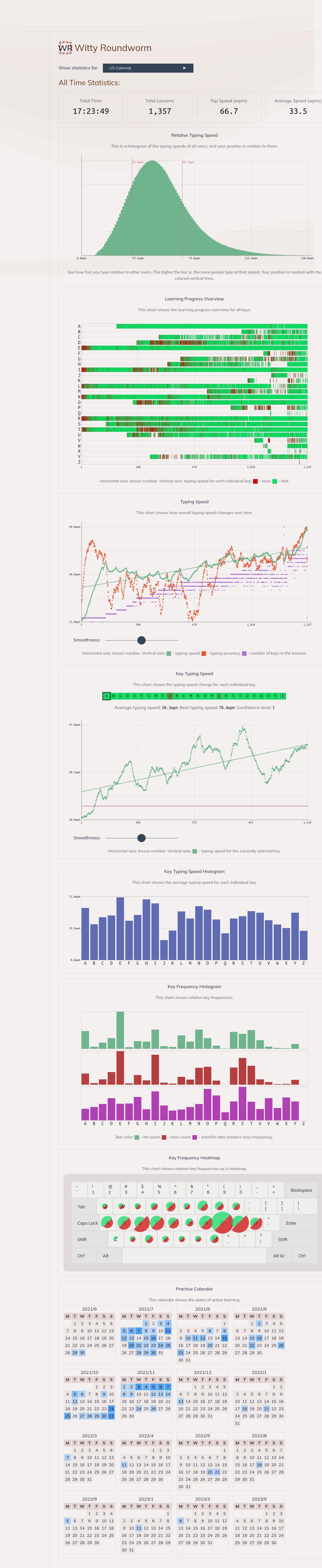
As I completed it, I was amazed by what I was able to accomplish. For most humans, in this modern age, muscle memory of typing is one of the most difficult things to change. But I did it. I got a massive sense of accomplishment. However, there was a huge problem that I did not anticipate. I was unable to use vim’s HJKL keys. This was a huge blow to my workflow. HJKL is used everywhere in the Unix world. ranger terminal file manager uses HJKL too.
Now, I took this as an advantage because already I am going to use Emacs anyway, and I didn’t need HJKL any more, so I ignored it for a while. As I got into Emacs, I went deep into elisp programming. It was new and exiting, I was able to extend my editor as much as I wanted, and it took my workflow to the next level. Since I am not using vim, I also have to discard using tmux too. Emacs had better window management and plenty of goodies that help me better than vim and tmux ever did.
I kept using Emacs + Colemak and my productivity improved significantly. Emacs also helped me write my first website with org more and org-mode to HTML publish mechanism. It was super useful. But, there is a big but, of course. It crashed. Crashed a lot. No matter what I did, it crashed on remote servers. Then my config files got so huge that I had to rewrite multiple times. Emacs also got slower and slower with each plugin I added. But vim was superfast, no matter how many plugins I added to it.
Finally, after 1 year of struggling with Emacs, I completely deleted and removed all the configs from my dot files repos and took what I learnt from this experience and went back to vim. Now I am back to vim and tmux combo and added some features that I liked from Emacs.
(This is my last Emacs config before I deleted it.)
My favourite things in Emacs are,
- Kill ring
- use-package
- e shell
- dired
- winner-mode
- compile-mode
- Emacs psycho therapist
- magit
- org-mode
- outline-mode
- which-key
- projectile
- yasnippet
- ivy, counsel, marginalia
- add-hook, hook concept
(+ 1 2 3)is not'(+ 1 2 3)(Walled garden)- The definition of buffer makes infinitely makes more sense than in vim
()- Parenthesis are beautiful. I repeat, it’s beautiful. Once you get used to it, your brain tunes it out and makes more sense than white space.
The funny thing is that Emacs key bindings can be used system-wide in macOS. Once I realized it, my life was so much better in macOS now.
My setup is a total Frankenstein monster now, it’s totally insane.
- vim + tmux for programming
- Colemak for typing
- but I can’t use hjkl as a vim user
- using Emacs bindings everywhere else
- I use arrow keys
- dafuq is this shit
It is amazing how my mind adapted all these concepts. If I like, I can still type in QWERTY by looking at the keyboard. Until now, I typed in Colemak. Now I am typing in QWERTY at almost the same speed as Colemak but with a bit more typing errors.
This is what I learnt from this whole experience.
- Basic text editing is more than enough.
- If you want to type and edit faster, find ways not to write code.
- Elevate your programming skills to the point where you don’t need to code, find ways to avoid it
- By doing this, you will realize that, you don’t need to write a lot of code to solve a problem that does not exist in the first place. You don’t need to write code for every single problem.

Whatever tickles your pickle bro.
But wait.
Did I ever tell you the definition of insanity? - Vaas, Far Cry 3